

Surya Namaskar (Sun Salutation) means a salute to the sun. It is a continuous series of 8 related Yoga postures, some done twice, in what totals 13 poses. It is designed to warm up your whole body and integrate the body, mind and breath. The Sun Salutation is a warm up or toning exercise and is considered the best of all Yoga exercises as it stretches, compresses, arches and reinforces all the major muscles of the body, as well as the digestive and respiratory organs. It also helps develop flexibility, strength, balance, concentration and focus. Sun Salutation is a great way to synchronize your breath and can be practised twice a day. Surya namaskar should be done minimum 12 times per day. Given below are the step by step instructions.

Namaskar (Salute)

Start in a standing position, facing the sun. Both your feet should touch each other, palms joined together, in prayer pose.

Ardha Chandrasana (Half Moon Pose)
With a deep inhalation, raise both arms above your head and tilt slightly backward arching your back.

Padangusthasana (Hand to Foot Pose)
With a deep exhalation, bend forward and touch the mat, both palms in line with your feet, forehead touching your knees.
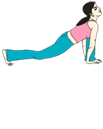
Surya Darshan (Sun Sight Pose)
With a deep inhalation, take your right leg away from your body, in a big backward step. Both your hands should be firmly planted on your mat, your left foot between your hands, head tilted towards the ceiling.
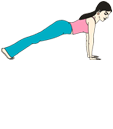
Purvottanasana (Inclined Plane)
Hold your breath and take your right leg back to join your left leg. Now straighten both your hands, legs and back. Your neck spine, thighs and feet should be in a straight line.

Adho Mukha Svanasana (Downward Facing Dog Pose)
With a deep exhalation, shove your hips and butt up towards the ceiling, forming an upward arch. Your arms should be straight and aligned with your head.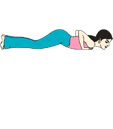
Sashtang Dandawat (Forehead, Chest, Knee to Floor Pose)
With a deep exhalation, lower your body down till your, forehead, chest, knees, hands and feet are touching the mat, your butt tilted up. Take a normal breath in this pose.
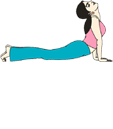
Bhujangasana (Cobra Pose)
With a deep inhalation, slowly snake forward till your head is up, your back arched concave, as much as possible.
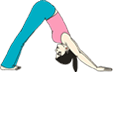
Adho Mukha Svanasana (Downward Facing Dog Pose)
Exhaling deeply, again push your butt and hips up towards the ceiling as in position 6, arms aligned straight with your head.
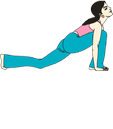
Surya Darshan (Sun Sight Pose)
Inhaling deeply, bring your right foot in towards your body, in a big forward step. Both your hands should planted firmly on your mat, right foot between your hands, head tilted towards the ceiling.

Padangusthasana (Hand to Foot Pose)
Exhaling deeply, rise up and touch the mat, keeping both your palms in line with your feet, forehead touching your knees.

Ardha Chandrasana (Half Moon Pose)
Inhaling deeply, raise both your arms above your head and tilt slightly backward.

Namaskar (Salute)
Return to stand facing the sun, both feet touching, palms joined together, in prayer pose.
Benefits of Sun Salutation
- You don't need to be doing yoga regularly in order to practice the Surya Namaskar. If performed correctly, this exercise does not strain or cause injury. If performed in the morning, it relieves stiffness, revitalises your body and refreshes the mind. Do it during the day and it will instantly boost you up, practice it after sundown and it helps you unwind.
- Not only does the Surya Namaskar give you a great stretch and keep you fit physically (it is extremely beneficial for your joints, ligaments and improves flexibility and posture), but is also does wonders for your mental and emotional health.
- Surya Namaskar stimulates almost every system in your body - the cardiovascular system because it keeps the heart strong and, the digestive system as well as the nervous system.
- It also makes endocrinal glands like the thyroid, parathyroid and pituitary glands, function normally.
- Practising the Surya Namaskar regularly is also known to ease stress and give you peace of mind besides increasing your levels of concentration.
- If you have trouble sleeping at night, the Surya Namaskar will help you fall asleep without using any external stimulants.
- It is said that twenty-four Surya Namaskars, if done properly, are equal to five hundred sit-ups / pull-ups. It may be a statement of exaggeration, but it is worth to experience the physical fitness that you attain after you start practicing the Surya Namaskar. At the beginning of the practice, one Surya Namaskar consumes 02.30 KCL. This exercise burns out a lot of calories and reduces body mass and body weight.
Contraindications
Sun Salutation is best avoided by pregnant women, people suffering from high blood pressure, or those nursing back aches or injuries, chronic glaucoma, heart problems.


